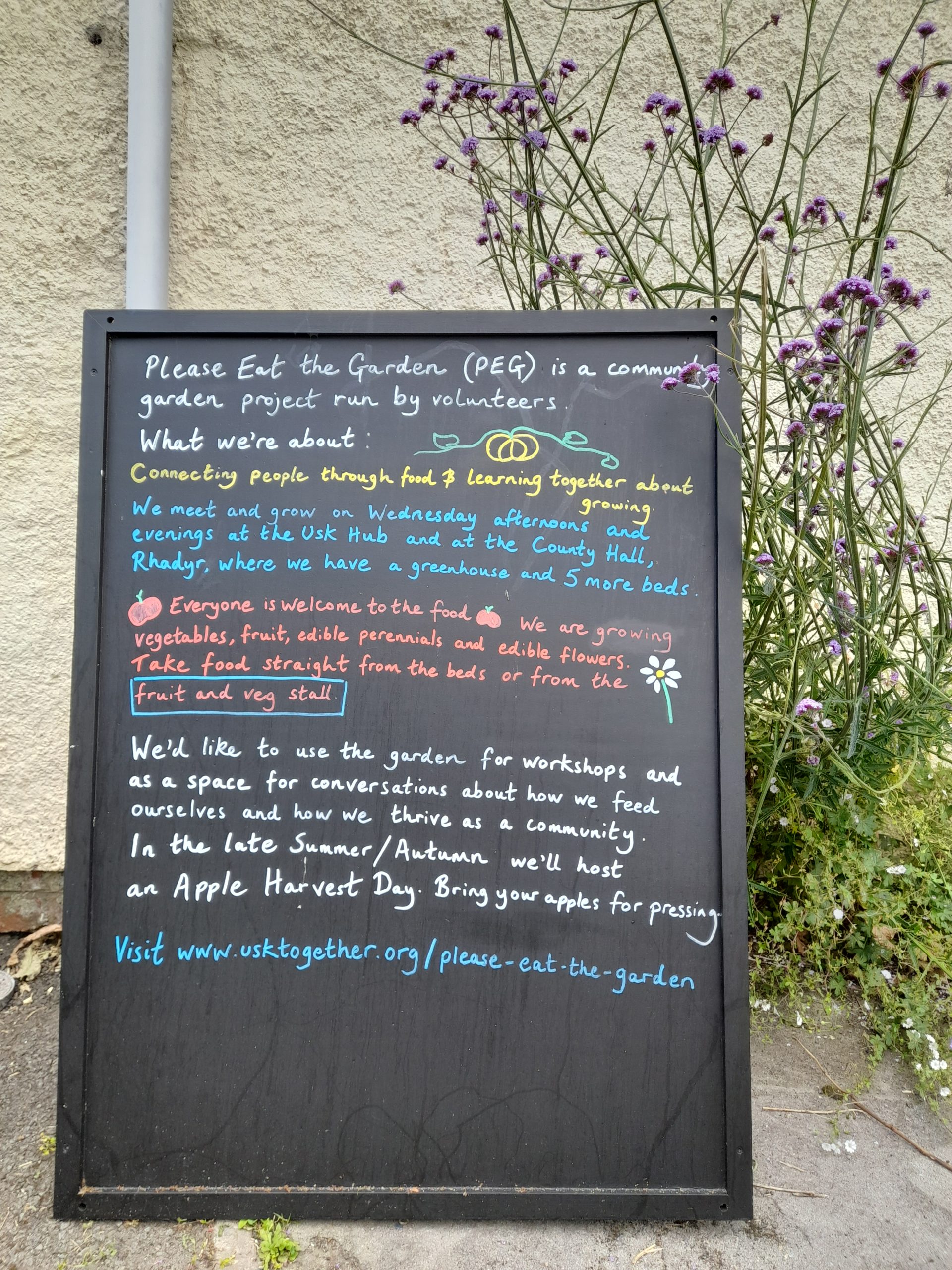
‘What we’re about’

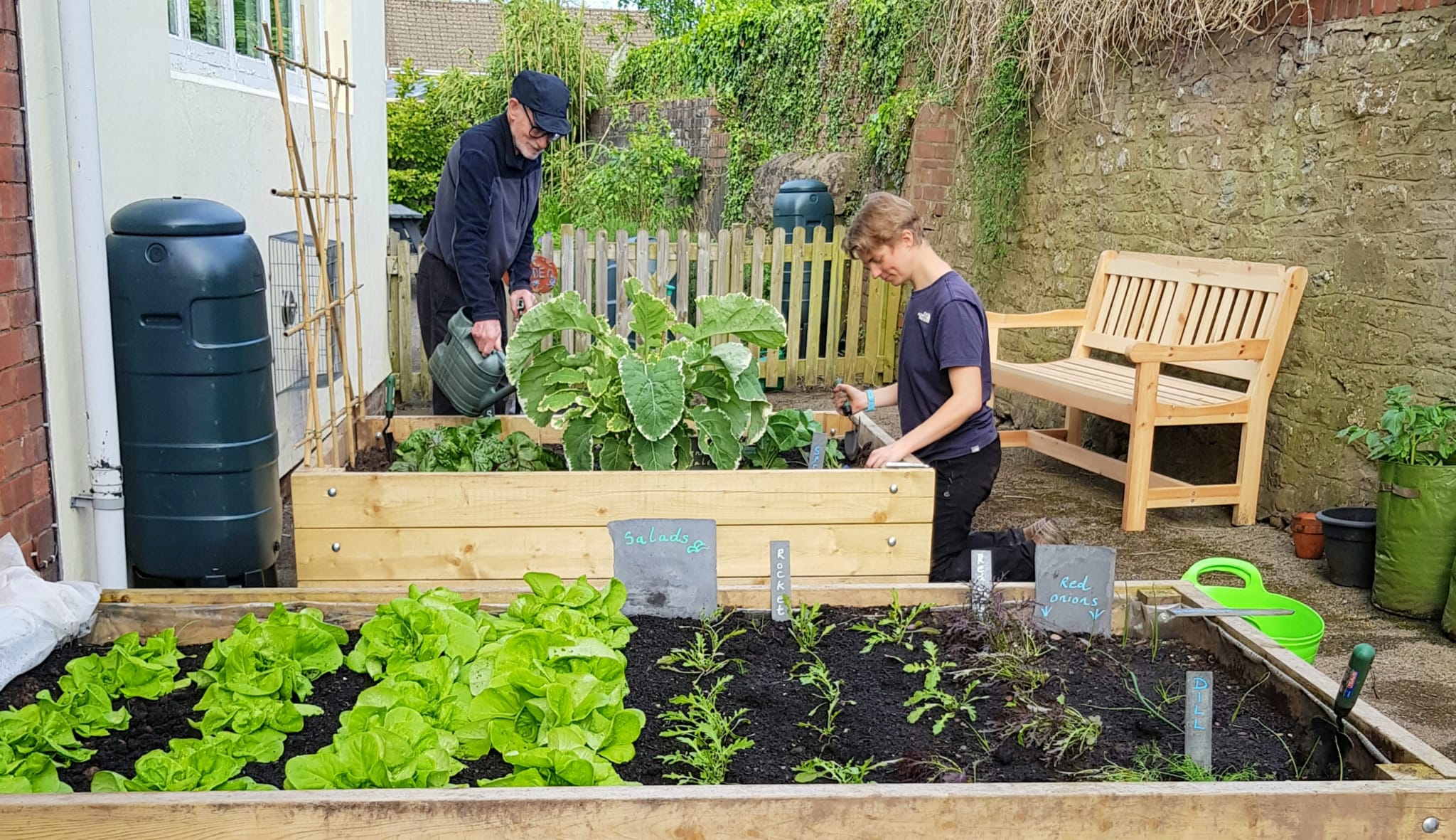
Watering in the afternoon sun
In 2023 Monmouthshire Food Partnership ran a community grants scheme open to third-sector organisations, community groups and social enterprises who are contributing to Monmouthshire’s good food movement. In this series of articles we are visiting some of the successful applicants to find out how they used their grants and what is happening now. Today we are with the Please Eat the Garden (PEG) project run by Usk Together for the Climate.
It is a hot and sunny late afternoon when I get to the garden, which is at the side of Usk Community Hub. I walk under a wooden arch and past pots and raised beds full of lovely, bushy, edible plants and flowers. Everything here is thriving and looks really, really healthy. Around the corner I find the volunteers, led by Cam, who are in the middle of one of their regular mentoring sessions from Grow Cardiff. Please Eat the Garden is a new initiative, and Cam and the other volunteers are working hard to set it on a firm footing so that everyone feels included in how the garden is run, and no one person carries too much of the load. Striking that balance is crucial for volunteer-led projects, so it is great to see everyone here thinking things through so carefully.
Usk Together for the Climate is an umbrella grouping for lots of local projects that all contribute to making Usk a more planet-friendly and climate-conscious town with a strong community feel. As Cam says,
‘The purpose of the PEG project is to provide opportunities to learn about food and growing and to nurture a sharing culture.’
And that is exactly what’s happening. The project has two sites: a main garden at the Community Hub and a feeder site in the public garden at County Hall, where the PEG team propagate plants in the greenhouses and store some of their bulkier equipment. Anyone can get involved in growing and caring for the plants, and – here’s the best bit – anyone can go along and harvest the produce. You don’t even need to be a regular volunteer: the food is there for everyone – delicious, fresh, and environmentally friendly. When a crop is ready, the volunteers usually harvest the produce and put it in the pantry area of the garden for people to take away; if there’s nothing in the pantry, just go into the garden and see what you can find. When I visited there was a variety of salad leaves and edible flowers ready for picking, with courgettes, beans and strawberries ripening not far behind. There’s nothing like a freshly picked sun-warmed strawberry, is there?
Monmouthshire Food Partnership’s grant watered the seed of the community’s ambition: the volunteers knew what they wanted to do, and our grant let them get on with it. As one volunteer put it:
‘We have transformed a barren, empty space into an attractive and productive garden and sitting area.’
The grant paid for the four raised beds, the welcome arch, and the shelves for the pantry, as well as a seed station, two fertilizer tea containers (to brew liquid fertiliser from nettles and comfrey), and plants, seeds, tools, and compost. Volunteer Jon Prince deserves a special mention for his work building the beautiful raised beds – and many thanks also to Usk Prison for donating two wooden benches, so visitors can sit and enjoy the garden around them.
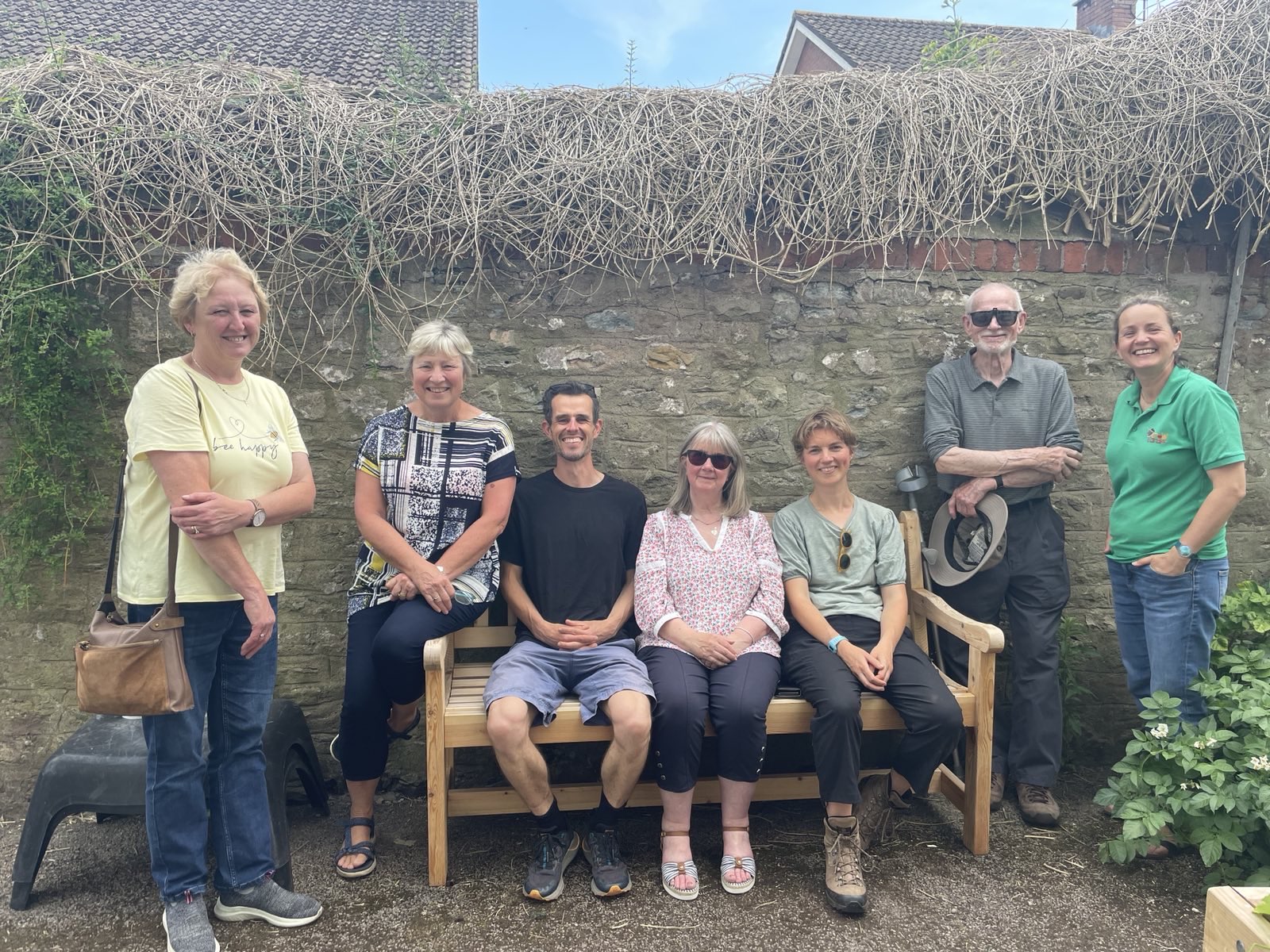
As the mentoring session draws to a close it is time to get to work. Out come the watering cans and everyone potters about nurturing the garden and noting changes since their last visit. It is clear that they all really love their garden, and they know exactly how much each plant has grown over the past couple of days. A bean plant is being closely watched as it makes its way up the arch day by day; the sorrel, which was causing anxiety a week or so ago, has recovered and is now thriving (it likes a lot of water, apparently); and although the broad beans are not climbing up their supports as they should, they’re still growing well. Someone notices that the strawberries are putting out runners, so Mike fills some pots with compost and nestles the long, pliable shoots into them. The runners will root, fed by the parent plant, and in a few weeks it will be safe to cut the runner – like cutting the umbilical cord after a baby is born – and the new plants will be able to live independently and get ready to flower and fruit next summer.
The wider community is getting involved too. The volunteers tell me they regularly meet people in the garden picking salad leaves like rocket and mustard (so expensive to buy, so easy to grow), and that their group of volunteers is gradually expanding as word gets out. There is a lot to do across the two sites, so every helping hand is welcome. As we’re working, Linda sets off to do her watering duty at the County Hall site and check on progress there. There is a well-planned watering rota, which depends on everyone remembering their slot so as not to let their fellows down. This really is teamwork in action as a community comes together to feed itself, as has been happening all over the world, all through history. You might think this is just a few vegetables in one little Welsh town, but it is part of something much, much bigger: the great story of people working together to harvest nourishment from sun, rain and soil, which has been unfolding across our planet for millennia.
As I get ready to leave, I ask a couple of the volunteers why they joined the project. There are lots of reasons: some joined for love of gardening, others to learn, others for companionship and to feel part of something worthwhile outside. It is clear from my visit that they’re all getting all those things – and some tasty food into the bargain.
And the future? Really, things are only just beginning at this special little community garden. They’re having a couple of launch events over the summer, and in the autumn they plan to host an apple harvesting day for their sister project, Together for the Pies. They’re also improving their signage and publicity and hoping to recruit some more volunteers. Longer term, they would like to use the garden for workshops, and less formally as a space for conversations about how we can feed our community and thrive while we’re doing it.